

DepEd Order No. 18, series of 2025 recently laid out the Implementing Guidelines of the Academic Recovery and Accessible Learning Program. The ARAL Program has four components but this series is focused on ARAL Program in Mathematics (ARAL-Mathematics),
Public school teachers had begun assessing learners with their proficiency levels within the first weeks of this school year. This post dissects the skill gaps for key stage 3, which means the learners are not proficient in Mathematics even if they are already in the higher grade levels.
Key Stage 3 Description
Based on the DO, Key Stage 3 (Not Proficient) is described as:
“The learner has difficulty with basic algebraic operations and foundational number concepts, including integers and fractions. They are unable to solve or represent simple equations or expressions, and show limited or no understanding of concepts such as functions, radicals, and percentages. In geometry, they can only identify basic shapes but cannot measure accurately or apply geometric formulas. They struggle with interpreting even simple graphs and do not grasp the basics of probability or data interpretation. Engagement in mathematical processes is minimal, and they often lack both confidence and accuracy when attempting tasks.”
Below is a detailed breakdown of skill gaps for Key Stage 3 (Not Proficient) learners, aligned with their struggles in algebra, number sense, geometry, and data interpretation:
Key Skill Gaps in Key Stage 3 Math
(Based on DepEd ARAL Program Focus Areas)
1. Foundational Number Concepts
- Integer Operations – Cannot add/subtract signed numbers.
- Fraction Basics – Fails to simplify or compare fractions.
- Decimal Conversions – Struggles with fraction-decimal-percentage relationships.
- Place Value Misapplication – Misaligns numbers in operations (e.g., 0.5 × 10 = 0.50).
2. Algebraic Deficits
- Solving Linear Equations – Cannot isolate variables (e.g., 2x + 3 = 7).
- Expression Translation – Fails to convert word problems to expressions.
- Function Misunderstanding – Cannot interpret input/output tables.
- Radical Simplification – Confuses √4 with 4².
3. Geometric Weaknesses
- Basic Shape Properties – Cannot name angles or parallel sides.
- Measurement Errors – Misuses rulers/protractors; units confused.
- Formula Application – Fails to apply area/circumference formulas.
- Transformations – Cannot reflect/rotate shapes on grids.
4. Data & Probability Gaps
- Graph Misreading – Interprets bar graphs as line graphs.
- Central Tendency – Confuses mean, median, mode.
- Probability Basics – Thinks “50% chance” means “always happens twice.”
5. Process & Mindset
- Problem-Solving Avoidance – Gives up after one attempt.
- Math Vocabulary – Misuses terms like “equation” vs. “expression.”
- Tool Misuse – Calculator errors; skips showing work.
Intervention Priority Ranking
- Most Critical:
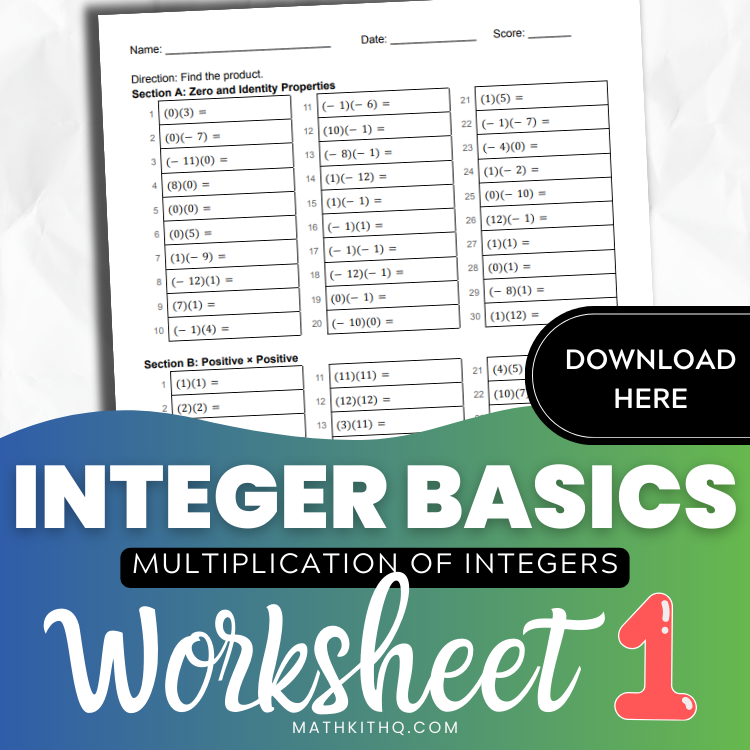
- Integer operations (#1)
- Fraction equivalence (#3)
- Linear equations (#5)
- Foundational for Advanced Topics:
- Function tables (#7)
- Geometric formulas (#11)
- Data literacy (#13)
- Confidence-Builders:
- Math vocabulary (#17)
- Step-by-step problem-solving (#16)
Example Gap Analysis: Integer Operations
Pre-Test: “Solve: (−3) + 5 = ___” → 70% errors
Root Cause:
- Misapplies rules (“two negatives make positive”)
- No number line visualization
Intervention Tools Needed:
- Visual: Colored integer tiles
- Kinesthetic: Number line hopscotch
- Digital: Interactive quiz with instant feedback
Leave a Reply